• Lx Elastic Pin Coupling
Lx Elastic Pin Coupling
+

Lx Elastic Pin Coupling

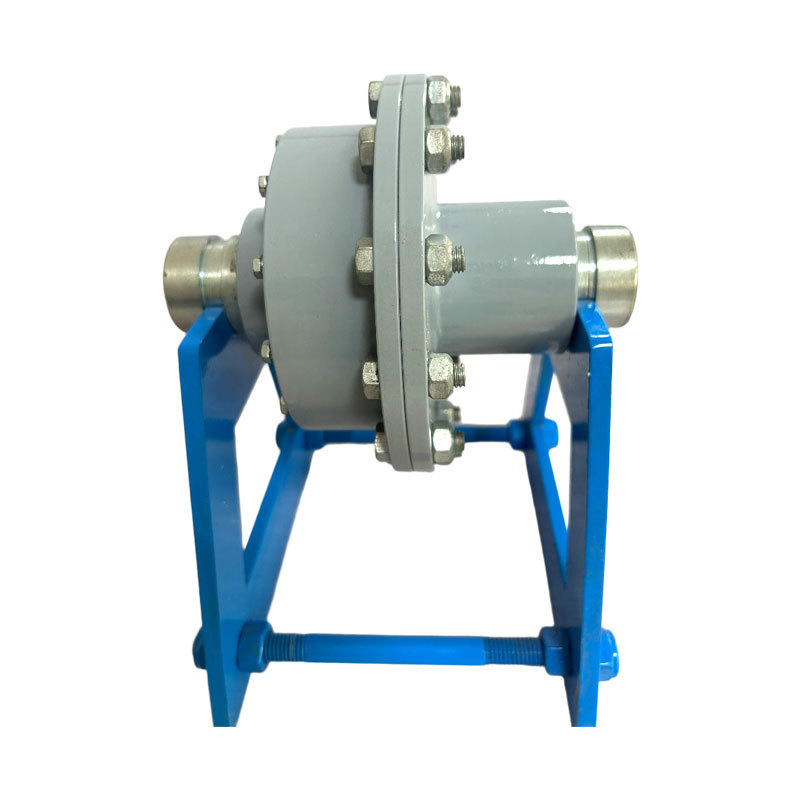
The Lx elastic pin coupling uses several non-metallic elastic pins inserted into the flange holes of the two coupling halves, thereby connecting the two halves via these pins. This coupling boasts a simple structure, is easy to manufacture, and allows for convenient installation, removal, and replacement of the elastic elements without requiring the two coupling halves to be moved.

Detailed introduction

Product Features
The Lx elastic pin coupling uses several non-metallic elastic pins inserted into the flange holes of the two coupling halves, thereby connecting the two halves via these pins. This coupling boasts a simple structure, is easy to manufacture, and allows for convenient installation, removal, and replacement of the elastic elements without requiring the two coupling halves to be moved.

Application scenarios
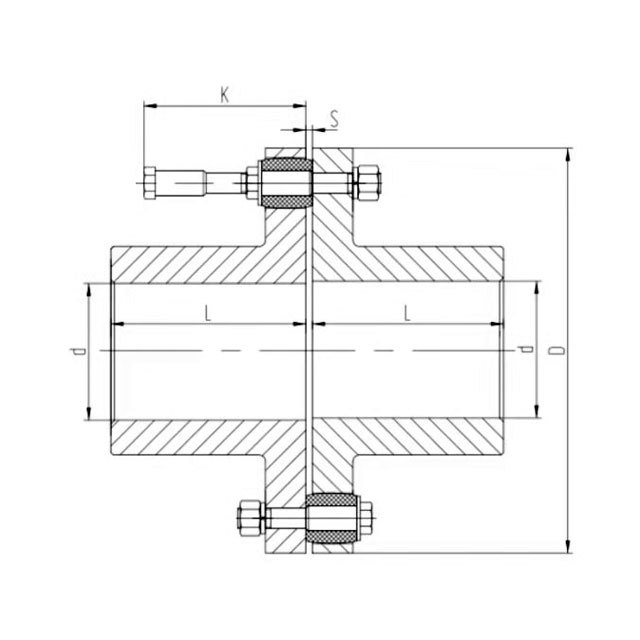
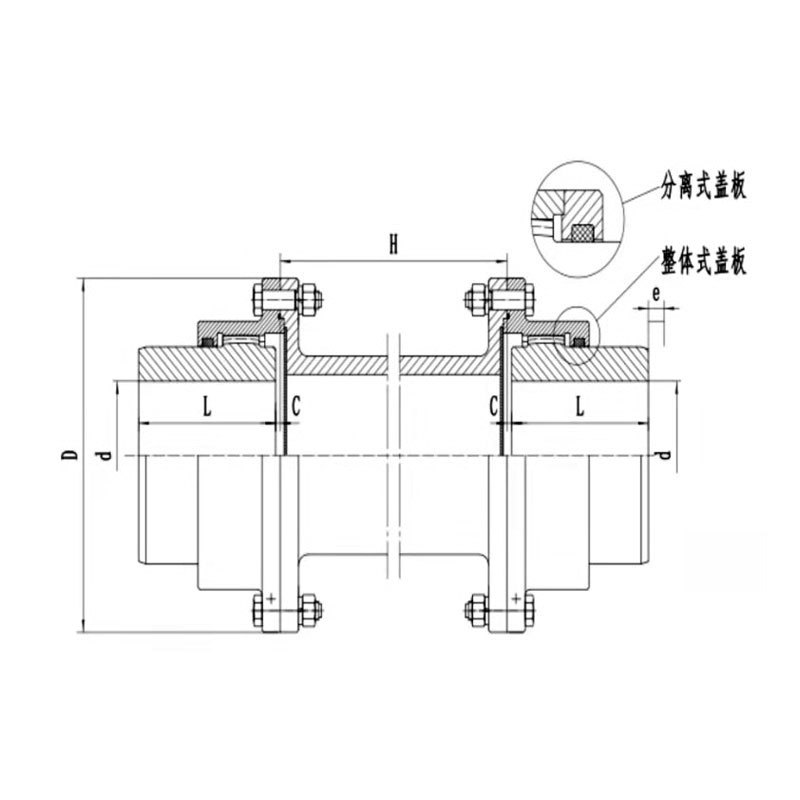
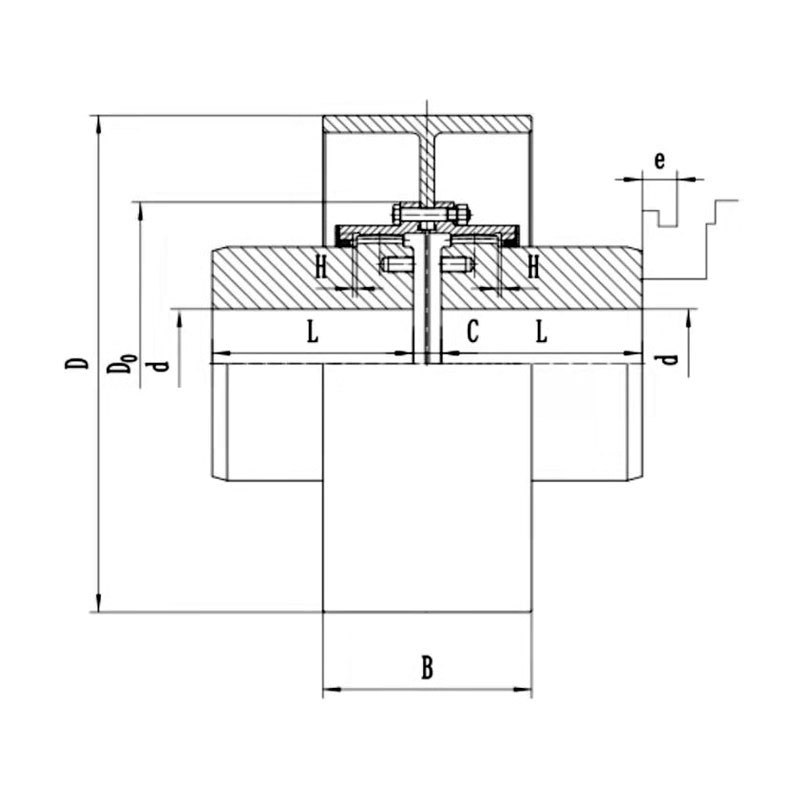
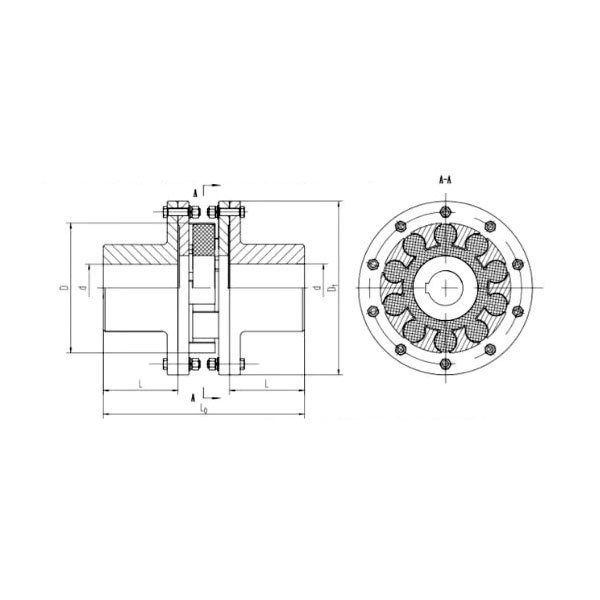
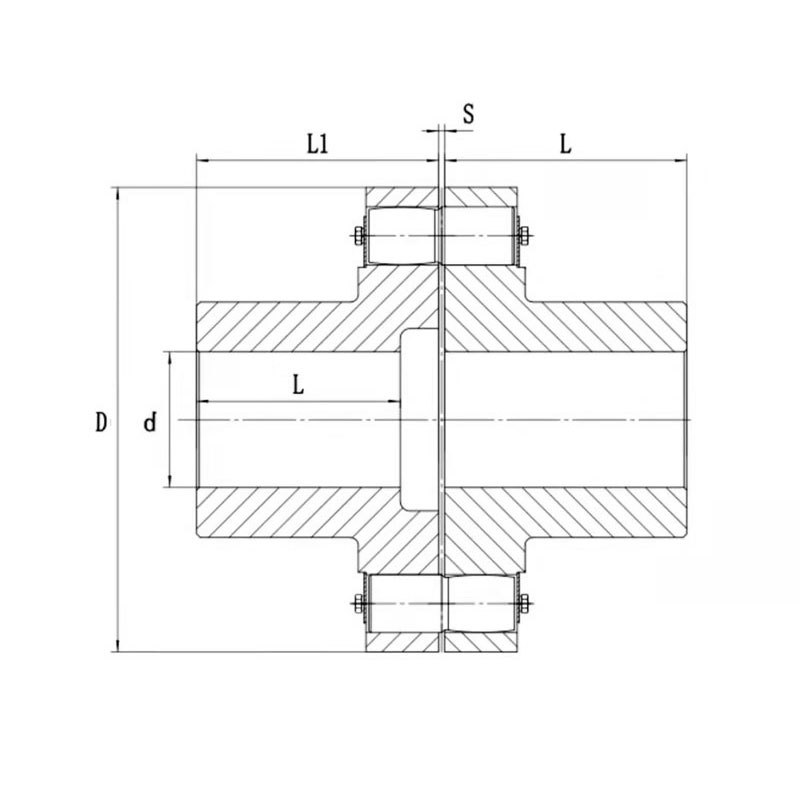
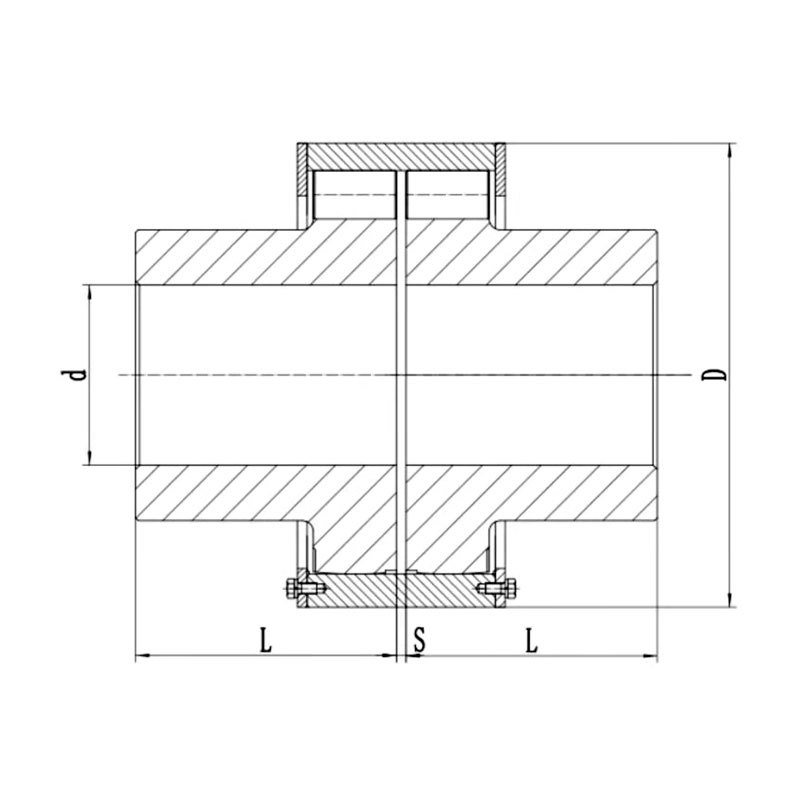
Suitable for transmission shaft systems connecting two coaxial shafts, this component features compensation for relative displacement between the two shafts and general vibration-damping performance. Its operating temperature range is -20°C to +70°C. The structural configuration is shown in Figure 7.1, and the technical parameters and main dimensions are listed in Table 7-1.


Figure 7.1 LX Elastic Pin Coupling


Table 7-1: Technical Parameters and Main Dimensions of the LX Elastic Pin Coupling

Model Nominal torque
/Nn
Permissible rotational speed
/rmin
Shaft hole diameter d
/mm
Shaft hole length / mm D/mm S/m Moment of inertia
/kg㎡
Quality
/kg
Permissible compensation amount
Y J, J1, Z Axial
△x/m
Radial
△y/mm
Angular
△a/°
L L L1
LX1 250 8500 12, 14 32 27   90 2.5 0.002 2 ±0.5 0.15 ≤0.5
15, 18, 19 42 30 42
20, 22, 24 52 38 52
LX2 560 6300 20, 22, 24 120 0.009 5 ±1
25, 28 62 44 62
30, 32, 35 82 60 82
LX3 1250 4700 30, 32, 35, 38 160 0.026 8
40, 42, 45, 48 112 84 112
LX4 2500 3800 40, 42, 45, 48, 50, 55, 56 195 3 0.109 22 ±1.5
60, 63 142 107 142      
LX5 3150 3450 50, 55, 56, 60, 63, 65, 70, 71, 75 220 0.191 30
LX6 6300 2720 60, 63, 65, 70, 71, 75, 80 280 4 0.543 53 ±2 0.2
85 172 107 172
LX7 11200 2360 70, 71, 75 142 107 142 320 1.314 98
80, 85, 90, 95 172 132 172
100.110 212 167 212
LX8 16000 2120 80, 85, 90, 95, 100, 110, 120, 125 360 5 2.023 119
LX9 22400 1850 100, 110, 120, 125 410 4.386 197
130, 140 252 202 252
LX10 35500 1600 110, 120, 125 212 167 212 480 6 9.760 322 ±2.5 0.25
130, 140, 150 252 202 252
160, 170, 180 302 242 302
LX11 50000 1400 130, 140, 150 252 202 252 540 6 20.05 520
160, 170, 180 302 242 302
190, 200, 220 352 282 352
LX12 80000 1220 160, 170, 180 302 242 302 630 7 37.71 714
190, 200, 220 352 282 352
240, 250, 260 410 330 -
LX13 125000 1080 190, 200, 220 352 282 352 710 8 71.37 1057 ±3
240, 250, 260 410 330 -
230, 300 470 380 -
LX14 180000 950 240, 250, 260 410 330 - 800 8 170.6 1956
230, 300, 320 470 380 -
340 550 450 -


Keywords

Previous page

None

Next page

None

Online Consultation


Contact us today for a free expert consultation!

%{tishi_zhanwei}%

Related Products


Diaphragm coupling

The diaphragm coupling is a metallic flexible coupling that can compensate for deviations in the radial, axial, and angular directions. Compared to conventional diaphragm couplings, it features a compact structure, strong corrosion resistance inherent in the diaphragm itself, high load-carrying capacity, light weight, and suitability for high rotational speeds.

T-type and D-type diaphragm couplings
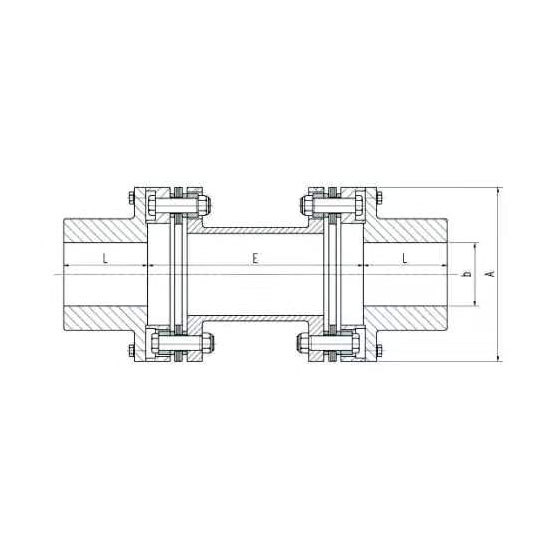
The diaphragm coupling compensates for the relative displacement between the two connected shafts through the elastic deformation of its diaphragm, making it a high-performance, metal-based flexible coupling with strong mechanical properties.

F-type diaphragm coupling

The F-type structure combines the advantages of both the R-type and G-type designs. For the same specification, the F-type has a greater shaft diameter capacity than the R-type and a smaller outer diameter than the G-type.

G-type diaphragm coupling

In addition to the key advantages of R-type couplings, the G-type coupling’s half-coupling features a larger shaft diameter capacity and can be manufactured with either straight bores or tapered bores (for hydraulic assembly and disassembly), or it can be conveniently connected to flanged shaft discs. The G-type is particularly well-suited for large electric motors, generators, or steam turbine units. Among all types of couplings, the G-type coupling is the easiest to assemble and disassemble.

R-type diaphragm coupling

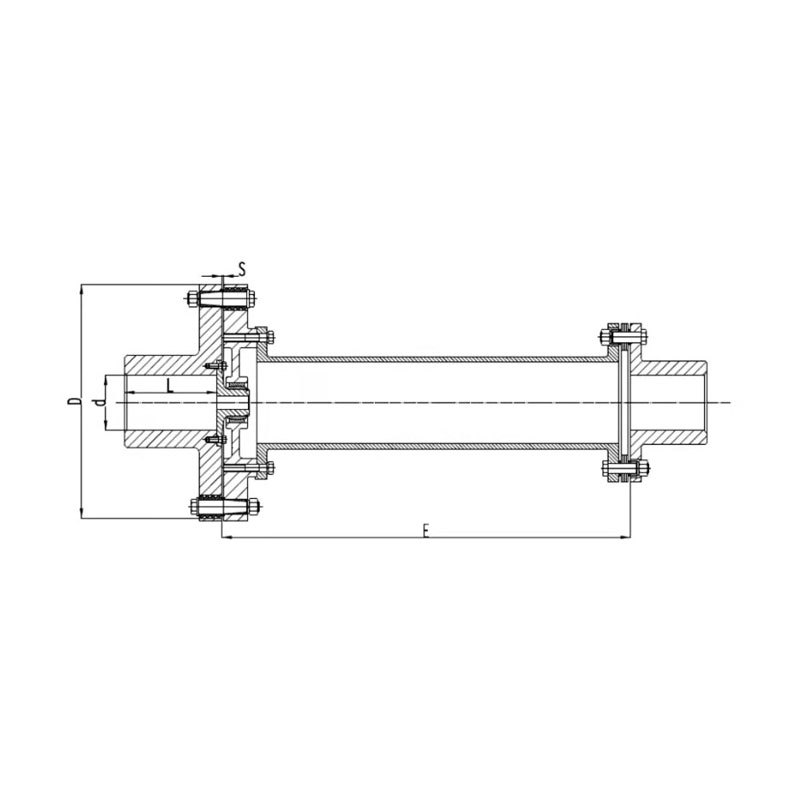
The R-type structure ensures that the center of gravity on both sides is as close as possible to the support bearings of the two units, minimizing additional bending moments at the rotor shaft end and thereby promoting smooth, high-speed operation. The flexible components—comprising the half-coupling, diaphragm assembly, and protective sleeve—have been fully assembled prior to leaving the factory and are connected via a stop collar on the intermediate section, allowing for easy overall assembly and disassembly. Even after multiple reassemblies and disassemblies, this coupling maintains permanent alignment and dynamic balance. The large distance between the two flexible elements (diaphragms) enables the coupling to effectively absorb misalignment between the units. The intermediate section—being sufficiently long—can be removed to facilitate easy disassembly of the half-coupling from the shaft without requiring any movement of the entire unit (the same applies during installation). Shims at both ends of the intermediate section can be added or removed to compensate for installation errors and to conveniently achieve pre-tensioning, thereby accommodating thermal expansion or other dynamic misalignments of the units.

NUP New Elastic Sleeve Pin Coupling
The NUP flexible coupling’s elastomer material is made of polyurethane reinforced with graphite, offering excellent toughness, self-lubrication, and wear resistance. It features a hollow-grid design and comes in three different elasticity options, providing superior vibration absorption and impact resistance. The conical-bore bolts ensure a tight fit that remains secure and does not loosen over time. Thanks to its high safety and reliability, as well as its outstanding vibration absorption and impact resistance, this coupling has received unanimous praise from more than 100 users. As a result, it has been awarded innovation funds by the Ministry of Science and Technology of China, the Provincial Department of Science and Technology, and the Municipal Science and Technology Commission.

NUPEX Combination Flexible Coupling

The NUPEX combination elastomeric coupling is a high-performance coupling developed and launched onto the market in 2000 by Schenck Power specifically for the characteristics of variable-frequency drive units. After successful application at the Jinxi Petrochemical Plant, more than 300 units have been installed to date, all operating smoothly and delivering excellent results.

GCLD Type Spherical Tooth Coupling

The drum-type gear coupling is a type of rigid-flexible coupling that can compensate for misalignment along the radial, axial, and angular directions. Compared with straight-tooth couplings, it offers advantages such as a compact structure, a small turning radius, high load-carrying capacity, high transmission efficiency, low noise, and a long maintenance interval.

GIICL-type drum-type gear coupling

The drum-type gear coupling is a type of rigid-flexible coupling that can compensate for misalignment along the radial, axial, and angular directions. Compared with straight-tooth couplings, it offers advantages such as a compact structure, a small turning radius, high load-carrying capacity, high transmission efficiency, low noise, and a long maintenance interval.

GIICLZ-type drum-type gear coupling

The drum-type gear coupling is a type of rigid-flexible coupling that can compensate for misalignment along the radial, axial, and angular directions. Compared with straight-tooth couplings, it offers advantages such as a compact structure, a small turning radius, high load-carrying capacity, high transmission efficiency, low noise, and a long maintenance interval.

WGT Type Drum-Type Gear Coupling

The drum-type gear coupling is a type of rigid-flexible coupling that can compensate for misalignment along the radial, axial, and angular directions. Compared with straight-tooth couplings, it offers advantages such as a compact structure, a small turning radius, high load-carrying capacity, high transmission efficiency, low noise, and a long maintenance interval.

NGCL Type Spherical Tooth Coupling

The drum-type gear coupling is a type of rigid-flexible coupling that can compensate for misalignment along the radial, axial, and angular directions. Compared with straight-tooth couplings, it boasts advantages such as a compact structure, a small turning radius, high load-carrying capacity, high transmission efficiency, low noise, and a long maintenance interval.

Compensating capacity for relative displacement between the two shafts of a drum-type gear coupling
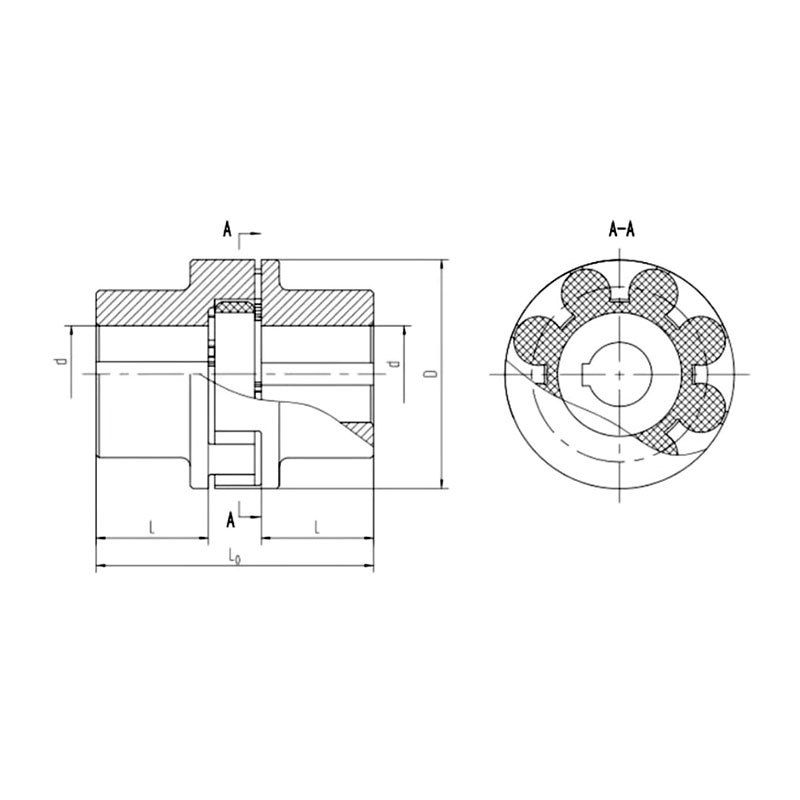
1) When there is no radial displacement between the two shaft axes, the permissible radial misalignment △α is as follows: For each pair of meshing internal and external teeth in a gear-type coupling with drum-shaped teeth, the permissible angular misalignment △α is 1°30'.

Wb-type rubber block coupling

The mechanical rubber coupling can transmit high torque and absorb impact generated by the rotating unit. It requires no lubrication, is easy to install and disassemble, and can operate in harsh environments such as those with moisture, sand, high temperatures, and other adverse conditions. It demands low maintenance and can significantly extend the service life of the equipment.

Cb-type rubber block coupling

The mechanical rubber coupling can transmit high torque and absorb impact generated by the rotating unit. It requires no lubrication, is easy to install and disassemble, and can operate in harsh environments such as those with moisture, sand, high temperatures, and other adverse conditions. It demands low maintenance and can extend the service life of the equipment.

LM-type梅花-shaped elastic coupling

The梅花-shaped elastic coupling consists of two identical half-couplings with claw-shaped protrusions and an elastic element. The梅花-shaped elastic element is placed between the claws of the two half-couplings to achieve their connection.

LMS-type梅花-shaped elastic coupling

The梅花-shaped elastic coupling consists of two identical half-couplings with claw-shaped protrusions and an elastic element. The梅花-shaped elastic element is positioned between the claws of the two half-couplings, thereby connecting them together.

Lx Elastic Pin Coupling

The Lx elastic pin coupling uses several non-metallic elastic pins inserted into the flange holes of the two coupling halves, thereby connecting the two halves via these pins. This coupling boasts a simple structure, is easy to manufacture, and allows for convenient installation, removal, and replacement of the elastic elements without requiring the two coupling halves to be moved.

Lz-type Elastic Pin-and-Tooth Coupling
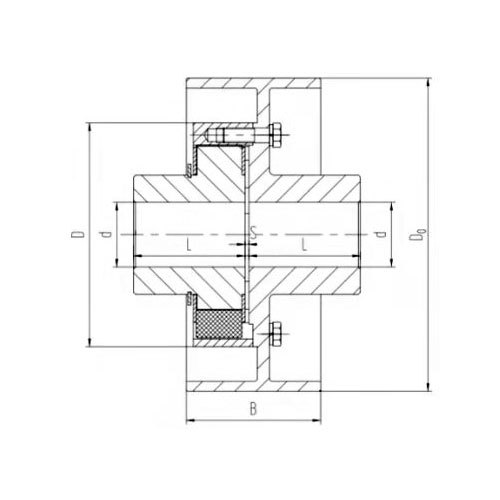
The elastic pin-type gear coupling uses several pins made of non-metallic materials, which are inserted into mating holes between the two halves of the coupling and the inner surface of the outer ring. Torque is transmitted through these pins, thereby connecting the two halves of the coupling.

LZZ Type Elastic Pin-and-Block Coupling with Brake Wheel

The elastic pin-type gear coupling uses several pins made of non-metallic materials, which are inserted into mating holes between the two halves of the coupling and the inner surface of the outer ring. Torque is transmitted through these pins, thereby connecting the two halves of the coupling.